
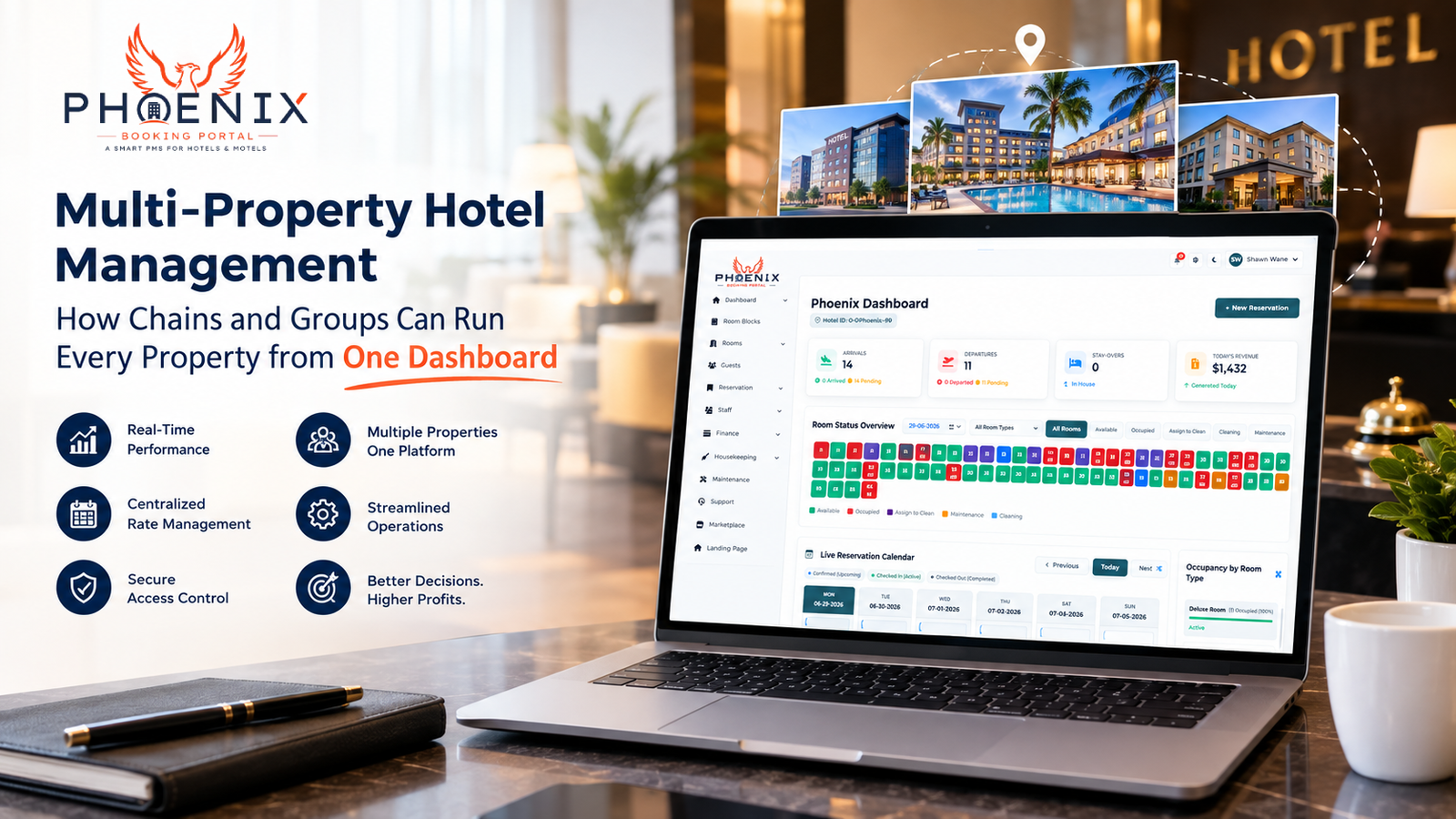
Managing multiple hotels feels like conducting an orchestra where every musician is in a different room. You’ve got occupancy reports scattered across emails, rate updates happening in five different systems, and housekeeping updates coming through WhatsApp chains. Sound familiar? That’s where multi-property hotel management software can make a real difference, bringing your properties, teams, and daily operations together in one centralized system.
If you’re running a hotel chain or management group, you know the struggle is real. That’s why multi-property hotel management software isn’t just a nice-to-have—it’s becoming essential for survival in today’s competitive hospitality landscape.
In this guide, we’ll explore how modern hotel chains and groups are taking control of their portfolios through centralized management systems. You’ll learn what features actually matter, how to avoid common implementation pitfalls, and why the right approach can save your team hours every single day.
What Makes Multi-Property Management Different (And Why It Matters)
Running a single property has its challenges, but managing multiple hotels introduces entirely new layers of complexity. When you’re overseeing 5, 10, or 50 properties, small inefficiencies multiply quickly.
Consider this: A 10-property group where each hotel manager spends just 30 minutes daily logging into separate systems to pull reports is wasting 5 hours every day—that’s 25 hours per week, or the equivalent of one full-time employee just doing data aggregation.
Multi-property hotel management software solves this by creating a single source of truth. Instead of jumping between systems, hotel executives and regional managers can:
- View real-time performance across all properties instantly
- Implement standardized processes while allowing for local flexibility
- Identify underperforming properties before issues become crises
- Distribute corporate initiatives and promotions uniformly
- Benchmark properties against each other for continuous improvement
The real magic happens when you stop treating each hotel as an isolated entity and start seeing your portfolio as an interconnected ecosystem where insights from one property can benefit others.
Core Features That Actually Move the Needle
Not all multi-property management tools are created equal. Many promise “centralized control” but deliver clunky interfaces that create more work than they save. Here are the features that genuinely impact hotel group operations:
Unified Dashboard with Drill-Down Capability
The best systems give you a helicopter view of your entire portfolio while letting you zoom into any property with just two clicks. You should be able to see:
- Portfolio-wide occupancy, ADR, and RevPAR trends
- Property-by-property performance comparisons
- Alerts for issues requiring immediate attention
- Customizable views based on your role (CEO vs regional manager vs revenue director)
Consistent Rate and Inventory Management
Imagine being able to update a corporate rate across 20 properties in seconds instead of manually logging into each PMS. Look for systems that allow:
- Corporate rate plans that cascade down to individual properties
- Inventory controls that prevent overbooking across your entire portfolio
- Channel management synchronization that works at both corporate and property levels
- Group booking visibility across all properties for events spanning multiple locations
Standardized Reporting with Local Flexibility
Corporate needs consistency; properties need relevance. The ideal solution provides:
- Pre-built corporate reports for ownership and investors
- Customizable property-level reports for general managers
- Automated report distribution schedules
- Data export capabilities for deeper analysis in Excel or BI tools
Role-Based Access Control
Not everyone needs to see everything. Effective multi-property software lets you:
- Set permissions by role (corporate, regional, property-level)
- Restrict sensitive financial data to authorized personnel
- Allow property managers to access only their relevant data
- Maintain security compliance across your entire organization
The Comparison: Manual vs Basic vs Cloud-Based Multi-Property Management
Let’s break down what different approaches actually look like in practice:
| Feature | Manual/Spreadsheet Approach | Basic PMS with Limited Multi-Property | True Cloud-Based Multi-Property Platform |
|---|---|---|---|
| Real-Time Portfolio View | Daily/weekly manual compilation | Delayed sync, limited metrics | Instant, comprehensive visibility |
| Rate Updates Across Properties | Individual property logins | Batch uploads, error-prone | One-click corporate rate distribution |
| Cross-Property Inventory Visibility | None | Limited to same-system properties | Real-time across entire portfolio |
| Standardized Reporting | Inconsistent formats | Basic templates, manual distribution | Customizable, automated delivery |
| Role-Based Access Control | All or nothing access | Basic user levels | Granular permissions by role/property |
| Mobile Access for Field Staff | None | Property-limited | Corporate and property-level apps |
| Implementation Timeline | N/A (already doing it poorly) | 3-6 months per property | 2-3 months for entire portfolio |
| Best For | Solo operator testing concepts | Chains under 5 properties with identical needs | Growing groups needing true scalability |
Deep Dive: How Centralized Rate Management Eliminates Revenue Leakage
One of the most painful (and expensive) problems for hotel groups is inconsistent rate management. When each property sets rates independently, you get:
- Rate parity violations that anger OTAs and direct booking customers
- Lost revenue from underpricing during peak demand
- Administrative overhead from constant manual corrections
- Brand dilution when sister properties compete on price
A true multi-property PMS solves this through hierarchical rate management. Here’s how it works:
Corporate teams establish base rate strategies and pricing rules that flow down to individual properties. Properties can then adjust within defined parameters based on local market conditions—think of it as “guided autonomy.”
For example, a beach resort group might set:
- Corporate rule: Summer rates must be 20% above winter baseline
- Property A (Miami): Can adjust ±10% based on local events
- Property B (Cancún): Can adjust ±15% due to different competitive landscape
- Property C (Bahamas): Can adjust ±20% considering its premium positioning
The system ensures no property falls below corporate minimums while allowing local teams to respond to their specific market dynamics. Hotels using this approach typically see:
- 8-15% reduction in rate parity complaints
- 5-12% increase in RevPAR from better peak-season pricing
- 70% reduction in time spent on manual rate adjustments
- Improved direct booking rates as price consistency builds customer trust
Implementation Best Practices: Avoiding Common Pitfalls
Implementing multi-property management software isn’t just about technology—it’s about change management. Here’s what successful hotel groups do differently:
Phase Your Rollout (Don’t Boil the Ocean)
Instead of trying to onboard all properties simultaneously:
- Start with 2-3 diverse properties as your pilot group
- Work out integration kinks and training approaches
- Refine your corporate processes based on real feedback
- Roll out to additional properties in waves of 3-5
- Use early adopters as internal champions for later groups
Invest in Proper Training (Not Just System Training)
The most successful implementations focus on:
- Role-specific training (what each person actually needs to do)
- Process training (how corporate and property workflows interact)
- Change management (addressing fears about losing autonomy)
- Ongoing support (not just a one-time training session)
One management group found that properties whose GMs received 2 hours of dedicated change management training adopted the system 3x faster than those who only got system training.
Define Clear Corporate vs Property Responsibilities
Before implementation, document:
- Which decisions remain at the property level (promotions, local partnerships)
- Which decisions require corporate approval (major rate changes, capital expenditures)
- What data flows upward vs what stays property-level
- How exceptions are handled and approved
This clarity prevents the “who decides what” debates that derail so many technology implementations.
Clean Your Data First (Seriously, Do This)
Garbage in, gospel out applies doubly to multi-property systems. Before migration:
- Standardize room types and rate codes across properties
- Reconcile historical data discrepancies
- Establish master charts of accounts for financial consolidation
- Create consistent guest profiles and loyalty program structures
Groups that spend 2-3 weeks on data preparation typically see 50% fewer post-launch issues and faster user adoption.
Quick Answers: Multi-Property Hotel Management
Q: What is multi-property hotel management software?
A: Multi-property hotel management software is a centralized platform that allows hotel chains and management groups to oversee operations, performance, and resources across multiple properties from a single dashboard. It provides real-time visibility into key metrics like occupancy, ADR, and RevPAR while enabling standardized processes and corporate-level control.
Q: How does multi-property management software differ from regular hotel PMS?
A: While regular PMS focuses on single-property operations, multi-property software adds portfolio-wide capabilities like centralized rate management, cross-property inventory visibility, consolidated reporting, and role-based access control that works across an entire hotel group rather than just one property.
Q: What size hotel group needs multi-property management software?
A: Groups with 3+ properties typically see immediate benefits from multi-property management software. Even smaller chains benefit from standardized processes and reduced administrative overhead, while larger groups (10+ properties) often see ROI within 3-6 months through operational efficiencies and better revenue optimization.
Q: Can multi-property software work with different PMS systems at each property?
A: Yes, modern multi-property platforms often integrate with various PMS systems through APIs or middleware. However, native integration (where all properties use the same PMS platform) provides deeper functionality and real-time synchronization that’s difficult to achieve with disparate systems.
Q: How long does it take to implement multi-property management software?
A: Implementation timelines vary based on portfolio size and complexity, but most hotel groups see: 2-3 months for small groups (3-8 properties), 4-6 months for medium groups (9-20 properties), and 6-12 months for large groups (20+ properties). Phased rollouts can deliver early wins while minimizing disruption.
Implementation Checklist: Getting Started with Multi-Property Management
Ready to take control of your hotel portfolio? Here’s a practical roadmap:
Assessment Phase (Weeks 1-2)
- Document current pain points and manual processes
- Map data flows between properties and corporate office
- Identify key stakeholders and their information needs
- Define success metrics and ROI expectations
- Research and shortlist potential vendors
Selection Phase (Weeks 3-4)
- Request demos focused on your specific use cases
- Check references from similar-sized hotel groups
- Evaluate integration capabilities with existing systems
- Review security certifications and data protection measures
- Negotiate contracts including implementation support
Preparation Phase (Weeks 5-6)
- Clean and standardize data across all properties
- Define corporate vs property-level responsibilities
- Establish rate and inventory management hierarchies
- Plan integration points with other systems (CRM, accounting, etc.)
- Develop communication plan for property staff
Implementation Phase (Weeks 7-14)
- Configure corporate settings and user roles
- Migrate historical data and establish master records
- Integrate with channel managers, POS systems, and accounting software
- Conduct property-level training sessions
- Go live with pilot properties and gather feedback
Optimization Phase (Ongoing)
- Monitor adoption rates and address user concerns
- Refine processes based on real-world usage
- Add advanced features like AI-driven forecasting
- Schedule regular business reviews with property teams
- Continuously train new staff and refresh existing users
Frequently Asked Questions
Q: Will multi-property management software make our properties feel less autonomous?
A: Actually, the opposite is often true. By automating routine corporate reporting and standardizing basic processes, corporate teams spend less time micromanaging and more time providing strategic support. Property managers frequently report feeling more empowered because they have better tools and clearer expectations rather than less autonomy.
Q: How much does multi-property hotel management software typically cost?
A: Pricing varies widely based on features and scale, but most hotel groups invest between $2-$8 per room per month for comprehensive multi-property platforms. Many vendors offer tiered pricing based on the number of properties or rooms managed. Remember to factor in implementation costs, training, and potential integration fees when calculating total investment.
Q: Can we keep using our existing PMS at some properties while adding others to the multi-property system?
A: Yes, many multi-property platforms support hybrid environments where some properties use the native system while others connect via APIs or middleware. However, functionality may be limited for non-native properties, particularly around real-time synchronization and deep operational integration. For maximum benefits, consider standardizing on a single platform over time.
Q: How does multi-property software handle different currencies and tax regulations?
A: Quality multi-property platforms include multi-currency support with automatic exchange rate updates and localized tax engines that can handle different VAT, GST, and regional tax requirements. Look for systems that allow property-level tax configuration while maintaining corporate-level financial consolidation in your reporting currency.
Q: What happens if we lose internet connectivity? Can properties still operate?
A: This is a critical consideration. Many cloud-based multi-property systems offer offline modes that allow properties to continue basic operations (check-ins, check-outs, etc.) during internet outages, with data syncing once connectivity is restored. Always ask vendors about their offline capabilities and data loss prevention measures.
Multi-Property Hotel Management: Why It Matters for Your Hotel
Managing multiple hotels doesn’t have to mean drowning in spreadsheets, chasing down updates, or feeling disconnected from your portfolio’s performance. The right multi-property hotel management software transforms complexity into clarity, giving you the insights and control needed to optimize your entire hotel group.
Ready to stop juggling systems and start seeing your portfolio clearly? Phoenix Booking Portal offers a comprehensive multi-property management platform designed specifically for hotel chains and groups. Start your free trial to experience how centralized management can save your team hours each day while improving revenue and guest satisfaction across all your properties.


Leave a Reply